The exposure value (EV) is probably the most important concept to understand before trying to get any other insight on photography. The EV indicates the amount of light that will be captured by the sensor during a shot.
The camera estimates the EV using as input the chosen aperture, the exposure time and ISO level, and most importantly, the scene brightness. It all gives as result a simple EV value.
Where is this indicator?
The indicator for the EV is different than the other indicators (which are simply numbers). The EV indicator usually looks like a rake. In the example below, the camera viewfinder shows an EV of 0 (zero).
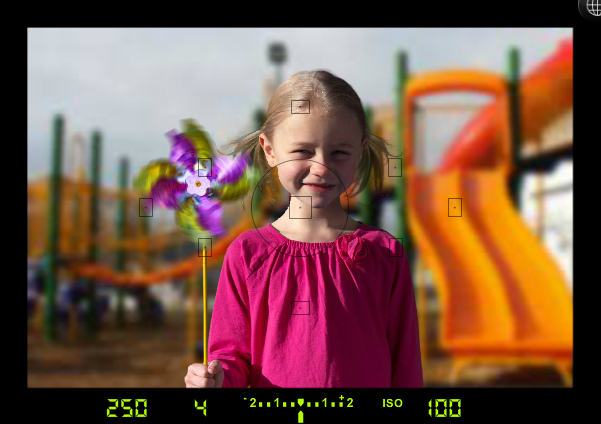
Do you see it? The little arrow pointing to 0 gives the EV. In this case we have correct exposure.
You must get used to reading this indicator in the viewfinder. It is your only way to know that exposure will be correct.
The EV is measured in [stops of light] (or simply [stops]). There is either correct exposure (EV = 0) or wrong exposure (EV != 0). For wrong exposure cases there will be either overexposure or underexposure.
Overexposure
Cases when there too much light will be captured by the sensor. It corresponds to cases with positive amount of stops of light (+1 or +2), and results of shots in such conditions will be pictures too bright.
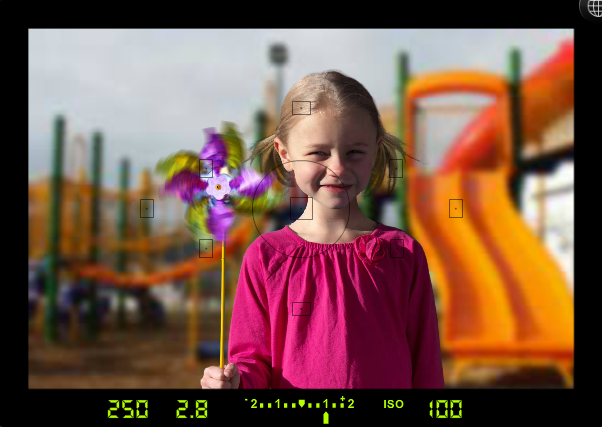
The resulting shot will be:

Correct exposure
Correct exposure is the case when the amount of light captured during the shot allows to reconstruct a good image, similar to what the human eye would perceive. It corresponds to cases with 0 stops of light.
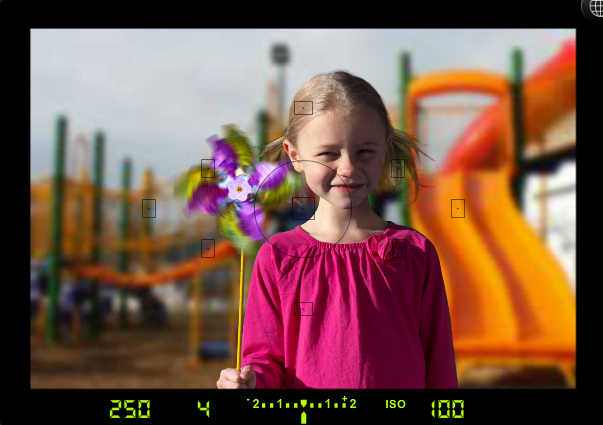
The resulting shot will be:

Underexposure
Underexposure occurs when a too low amount of light is captured by the sensor. It corresponds to cases with negative EV (-1 or -2 stops), and shots in such conditions will result in a picture too dark.
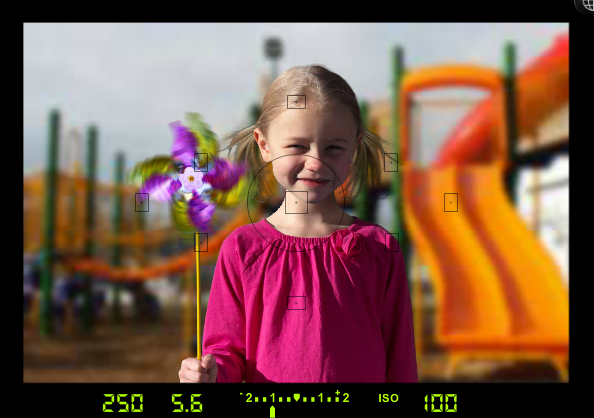
The resulting shot will be:
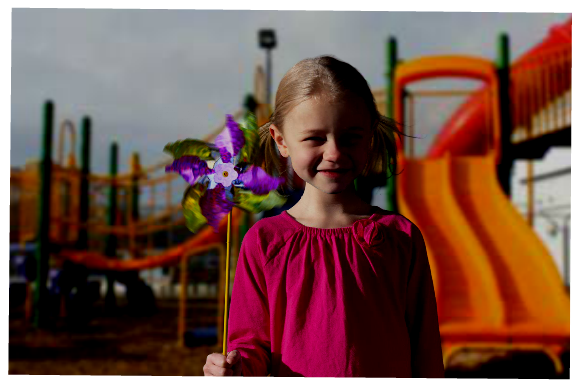
About wrong exposures
DSLR cameras also indicate wrong exposure making other indicators blink in the viewfinder. As a rule of thumb, if there is an indicator blinking, something is going wrong.
In wrong exposure situations, for Shutter priority or Aperture priority modes, the indicator that blinks if there is wrong exposure depends on the mode chosen. For instance, if mode is Shutter priority, then on wrong exposure situations Shutter speed (Exposure time) will blink. On the other hand, if mode is Aperture priority, the aperture indicator will blink. This will be addressed in a different post, about Priority modes.
To keep in mind
This is a rule that I find very interesting. One stop of light is lost (or gained) as a consequence of halving (or doubling) any of the three main factors that control the amount of light: exposure time, aperture, or ISO. As an example: if you have EV -1, you can either: double the exposure time, double the aperture, or double the ISO. On the other hand, if you have EV +1, you can either: halve the exposure time, halve the aperture, or halve the ISO.
Play with it!
Put it in manual mode. Use the following reference settings: ISO 800, f/9 and shutter (exposure time) 1/400 seconds.
- Check what is the EV for such case. Take a picture and see what correct exposure looks like.
- Keep the manual mode. Play a bit with each shooting parameter to verify that doubling any of ISO, aperture or shutter leads to increasing the EV by one stop of light. For instance, taking ISO from 800 to 1600 results in EV +1. The same way, increasing the shutter (exposure time) from 1/400 to 1/200 increases EV by +1 stop of light.
- Keep the manual mode. Play a bit with each shooting parameter to verify that halving any of ISO, aperture or shutter leads to decreasing the EV by one stop of light.
What now?
I strongly recommend you to get use to the numbers of this shooting parameter. You should be able to answer questions like “what does EV=+1 mean?” and “how many ways of correcting such EV do we have?”.
After that you can go to the next step: ISO level

No comments:
Post a Comment